Precise clinical documentation and accurate coding are what stand between the care you provide and the payment you're owed. Incomplete documentation means underpayment, denials, and audit risk. Our CDI program improves documentation quality at every stage — concurrent and post-discharge — so every service is captured, coded, and reimbursed correctly.
HIPAA-compliant, Fort Worth, Texas-based revenue cycle management. Scionis RCM operates under strict data-privacy protocols and standardized billing methodologies aligned to HIPAA requirements, helping US healthcare practices reduce compliance and audit exposure across every specialty we serve.
Inaccurate or incomplete clinical documentation is one of the most expensive problems in healthcare, because it drives underpayment, denials, and audit exposure all at once, and the rules keep changing.
Under-documentation: care provided but not fully captured, leading to underpayment
Incorrect coding: documentation that doesn't support the codes billed, triggering denials
Audit risk: gaps between documentation and billing that expose you to audits and penalties
Changing standards: ICD-10 updates and payer-specific rules that are hard to keep pace with
Sound familiar? At Scionis RCM, our CDI program closes the gap between the care delivered and the documentation that justifies payment for it.
Get a Free CDI AssessmentOur expert teams review clinical documentation in real time and after discharge, ensuring it's accurate, complete, and compliant with current coding standards. Catching documentation gaps early, before billing, is what reduces denials, secures full reimbursement, and lowers your audit risk, all without adding burden to your clinical staff.
Expert teams review documentation in real time during care, identifying gaps early so they're corrected before billing.
Thorough post-discharge audits ensure all details are captured, coded correctly, and billed accurately.
Accurate, compliant ICD-10, CPT, and HCPCS coding so every service provided is billed correctly.
AI-driven tools automate and streamline documentation and coding workflows, improving accuracy and speed.
Automating routine coding tasks reduces the burden on clinical staff while ensuring consistency and accuracy.
Robust security protocols protect patient information while maintaining HIPAA and regulatory compliance.
Clinical documentation improvement spans the entire encounter — from real-time review during care to post-discharge audits and provider queries. We cover the full CDI continuum, so documentation supports both quality care and correct reimbursement.
Real-time documentation review during the stay to close gaps before discharge and billing.
Retrospective audits ensuring every detail is captured, coded, and billed correctly.
Compliant physician queries that clarify documentation without leading the provider.
Documentation reviewed to support correct MS-DRG/APR-DRG assignment and severity capture.
Audits that surface gaps between documentation and codes before payers do.
AI-driven tools that flag documentation gaps and streamline coding workflows.
Provider and staff training on documentation best practices and coding changes.
Ensuring documentation captures the full acuity and services for complete reimbursement.
Documentation that holds up under payer and regulatory scrutiny.
Precise clinical documentation and accurate coding are critical not only for proper reimbursement but also for reducing the risk of audits and compliance issues. We offer a comprehensive range of services designed to enhance the accuracy and integrity of clinical documentation, both during patient care and post-discharge. Our focus is a seamless process that supports compliance, maximizes revenue, and reduces administrative burden, closing the gap between the care delivered and the documentation that justifies payment for it.
Documentation is the source of truth the entire revenue cycle depends on: a service that isn't documented can't be coded, a code that isn't supported can't be defended, so improving documentation quality upstream improves reimbursement and audit-readiness everywhere downstream at once.
Providers face constant challenges maintaining high standards of clinical documentation and coding accuracy. Inaccurate documentation leads to underpayment, denial of claims, and increased audit risk, and the complexities of changing coding standards, such as ICD-10 updates and payer-specific requirements, make it hard to stay ahead. Our CDI solutions streamline these processes, ensuring every aspect of the care provided is accurately recorded and coded, which connects directly to our medical coding process.
Manual documentation processes lead to inefficiencies and errors. We integrate advanced technologies, including AI-driven tools, to automate and streamline documentation and coding workflows. Automated coding assistance reduces the burden on clinical staff while ensuring consistency, and real-time analytics provide instant insight into documentation practices, helping identify areas for improvement, all on platforms built with robust security to maintain HIPAA compliance.
Providers struggle with under-documentation, incorrect coding, and the administrative burden of ever-changing regulations. Our program addresses these head-on: reducing audit risk through proper documentation and coding, ensuring full reimbursement so all services rendered are billed correctly, and improving workflow efficiency so staff spend less time on manual tasks and more time on patient interactions. This ties into our regulatory compliance work.
Precision in documentation and coding is essential for accurate billing, compliance, and financial stability. Better documentation means fewer denials, fuller reimbursement, lower audit risk, and less administrative rework, and because documentation sits upstream of the whole revenue cycle, improving it produces returns at every stage after it. It's one of the highest-leverage investments in revenue integrity a provider can make.
Precision in clinical documentation and coding is essential for accurate billing, compliance, and financial stability. With our tailored CDI solutions, you improve documentation quality, reduce audit risk, and optimize reimbursement, so your organization can enhance its financial performance while you focus on providing exceptional patient care.
Enhanced clinical documentation pays off in three ways at once: fuller reimbursement, lower audit risk, and less administrative burden — all flowing from the same improvement in documentation quality.
Accurate, complete documentation ensures that all services rendered are captured and billed correctly, so you receive full payment for the care you provide. Because underpayment usually traces back to under-documentation rather than under-treatment, improving the record is often the most direct way to recover revenue you've already earned clinically.
AI-assisted tools and automated coding assistance reduce the burden of documentation and coding on clinical staff, while streamlined processes cut time spent on manual tasks. The result is documentation improvement that strengthens revenue and compliance without pulling clinicians further from patient care, which is what makes a CDI program sustainable.
Because documentation is the upstream source the entire revenue cycle draws from, improving it is one of the few changes that simultaneously raises reimbursement, lowers audit risk, and reduces rework, rather than trading one against another.
As a billing company, we have worked with several RCM vendors, but none have matched the level of service and results we've seen with Scionis RCM. Their technology-driven solutions and expert team have made our processes smoother and more efficient, which has led to increased client satisfaction. They are truly a trusted partner.
Our healthcare network has greatly benefited from the efficient and accurate services provided by Scionis RCM. Their commitment to reducing administrative burden and optimizing our revenue cycle has been a key factor in our growth and success. They are not just a service provider but a vital extension of our team.
Partnering with Scionis RCM has been a game changer for our practice. Their expertise in streamlining revenue cycle management has allowed us to focus on what we do best, caring for our patients. They have significantly reduced our claim denials and improved our cash flow. We couldn't ask for a better partner.
CDI is the process of improving the accuracy, completeness, and compliance of clinical documentation, so that the record fully captures the care provided and supports correct coding, reimbursement, and audit-readiness.
Concurrent reviews happen in real time during care, catching documentation gaps early so they can be corrected before billing. Post-discharge audits review documentation after care to ensure everything was captured, coded, and billed correctly.
Underpayment usually results from under-documentation, not under-treatment. When documentation fully captures the acuity and services provided, coding can reflect it accurately, so you're reimbursed for the full care delivered.
Yes. By aligning documentation with the codes billed and catching gaps early, proper CDI practices minimize the discrepancies that trigger audits and the penalties that can follow.
Yes. We integrate AI-driven tools and automated coding assistance to flag documentation gaps and streamline workflows, improving accuracy and speed while reducing the burden on clinical staff.
Yes. Our platforms are built with robust security protocols that protect patient information while maintaining HIPAA and other regulatory compliance.
Yes. We review documentation to support correct MS-DRG and APR-DRG assignment and severity capture, which is central to accurate inpatient reimbursement.
No — the opposite. Compliant queries and AI-assisted tools are designed to reduce the documentation burden on clinical staff while improving quality, so clinicians spend more time with patients, not less.

Recovering revenue lost to time-unit and concurrency errors in anesthesia billing.
Read more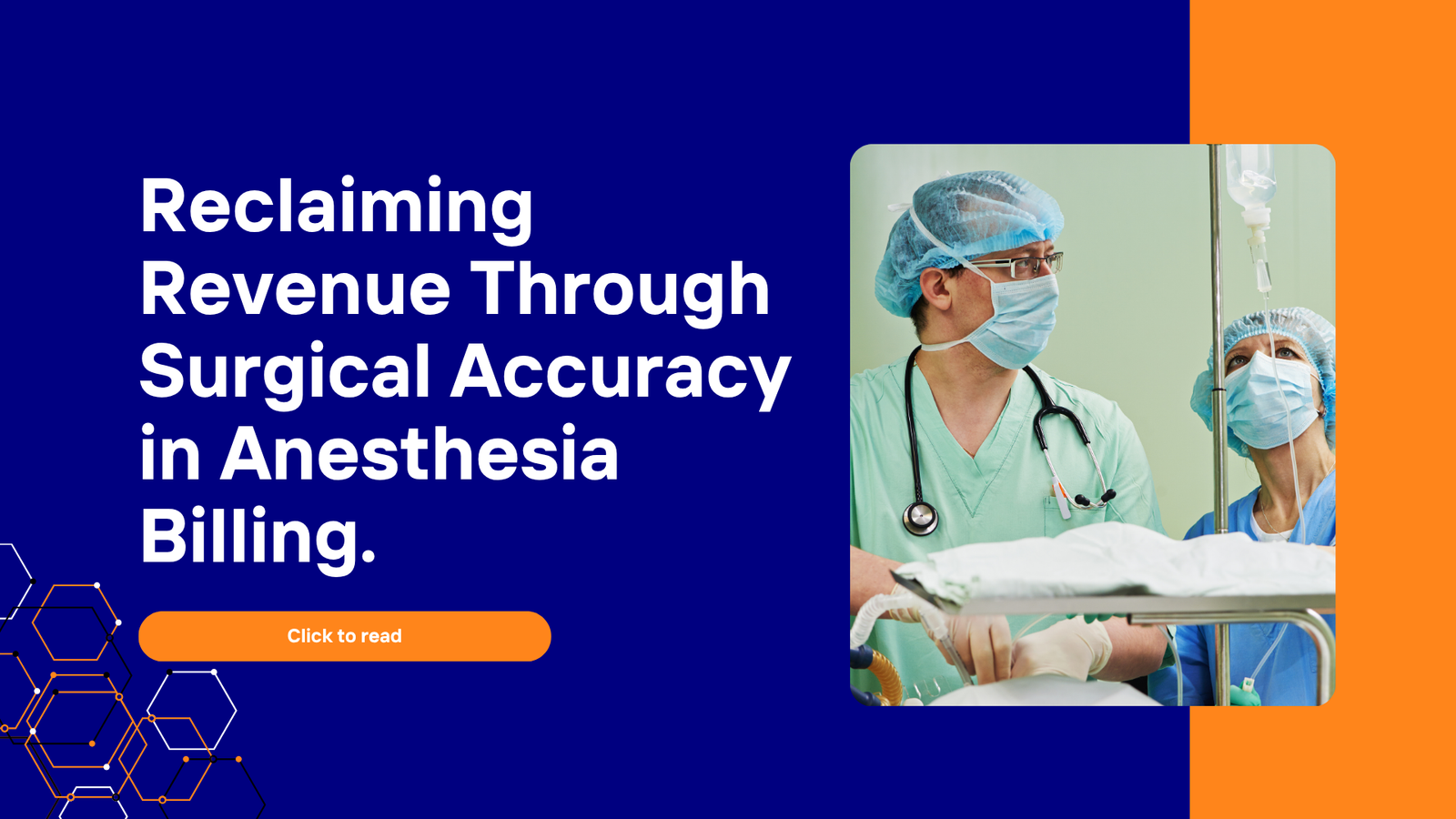
Where anesthesia revenue leaks down to the minute — and how to close the gap.
Read more
A closer look at coding workflow optimization for a multi-site radiology group.
Read more